
From intelligence gathering to high endurance patrols, navies across the globe are facing more threats than ever before, increasing demand on scarce resources. To ensure our customers stay ahead in an evolving maritime world, we are constantly embracing new technologies.
In collaboration with our customers, we are integrating with, and enhancing, the mission capability of crewed platforms, working together across government and industry to meet evolving threats and ensure mission success.
AROS
Launched in 2025, our AROS products will further enhance autonomy across the maritime domain, providing assurance that remote assets are performing as required and ensuring safe outcomes for crew and vessels.
Platform controller
Awarded an Approval in Principle (AiP) by DNV the AROS Platform Controller provides a critical integration point for mission autonomy, C2 and payload systems. It has been developed to comply with international industrial standards and ensure safe vessel operation across both crewed and uncrewed scenarios.
Backed by our 30-year experience in developing vessel systems integration, the controller provides a standardised interface between engineering and navigational systems, supervising critical information and enabling full autonomy when connected to vessels equipped with MARINELINK-Prime and a compatible navigational autonomy system.
Console
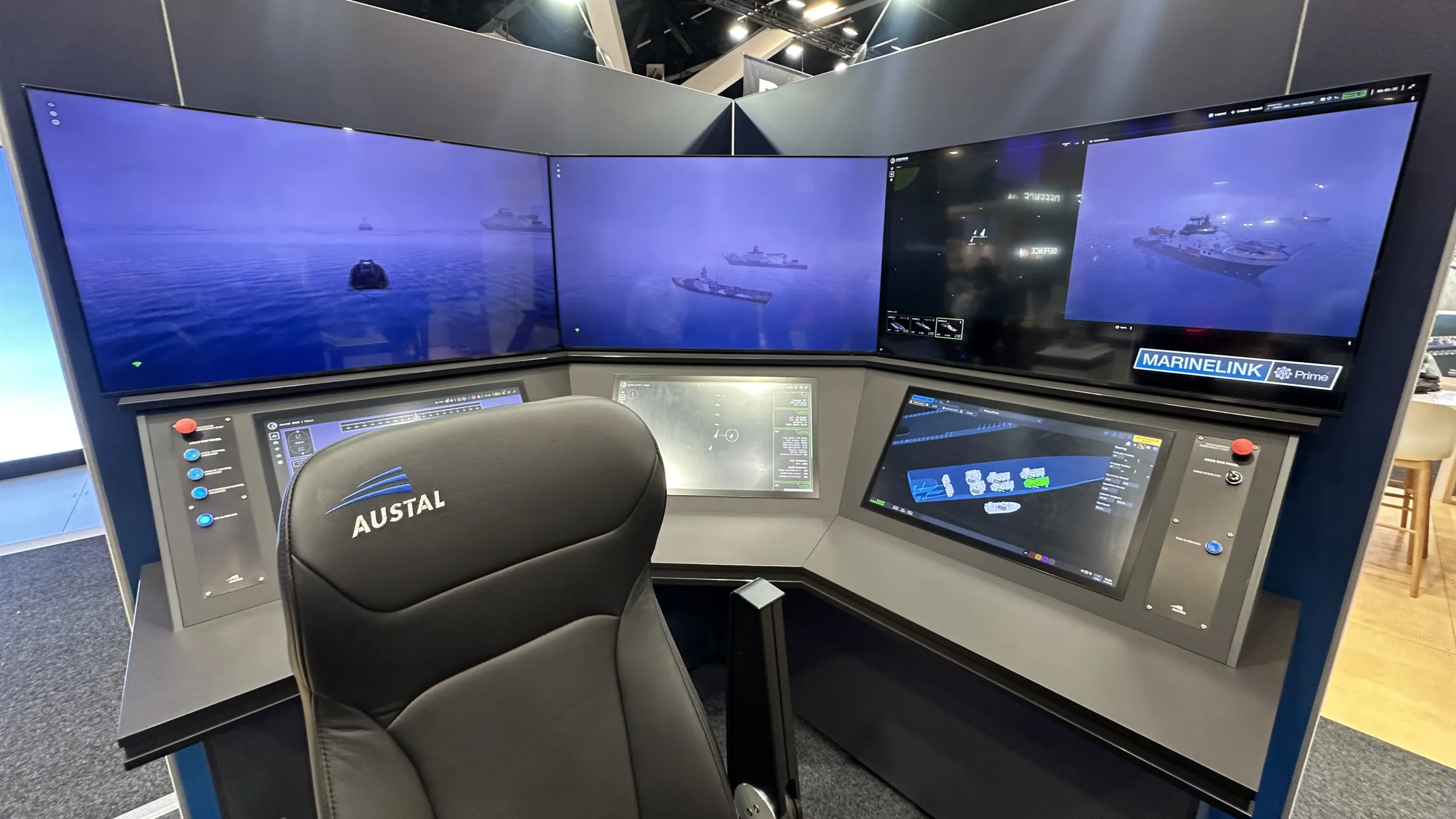
The AROS Console is designed to be fitted on new or existing vessels, enabling the remote operation and tasking of autonomous and uncrewed assets, complimenting shore-based operations and supporting crewed-uncrewed teaming (MUM-T).
Developed in collaboration with Greenroom Robotics, the console enhances Australia’s sovereign capability to deliver support for optionally crewed vessels and uncrewed assets being delivered for future maritime forces.
The console provides three main stations
- Remote piloting, with both touch input and physical controls, for uncrewed surface vessels (USV), remotely operated vessels (ROV) and uncrewed air vehicles (UAV).
- Asset tasking, mission planning, course plotting and target interactions.
- Remote engineering of multiple assets, allowing crews to administer engineering functions, fulfilling both regulatory requirements and further enabling mission success.
Optionally crewed surface vessel class
Vantage
Developed as an autonomy-ready platform to enable increased long-range presence and enhancement of existing crewed assets without associated personnel pressures, Vantage is available in 25 and 55 metre variants. Able to be operated by a crew, remotely (from ship or shore) or by their fully autonomous systems, both variants provide scalable, affordable capability and accommodate flexible payloads through standard containerised interfaces.

Collaborating with customers to demonstrate autonomous technologies
Australian Patrol Boat Autonomy Trial (PBAT)
The Patrol Boat Autonomy Trial (PBAT) brought together our experience as the world-leading maritime vessel designer and manufacturer of the Armidale Class Patrol Boat, with Greenroom Robotics ‘GAMA’ maritime autonomy technology to develop a proof-of-concept demonstration of autonomous capability, guided by Trusted Autonomous Systems, for the Commonwealth of Australia.


